
Choosing between container storage vs self storage in Doncaster comes down to access, what you’re storing and how often you’ll need to visit. This guide compares drive-up containers and indoor units on convenience, security, damp prevention and value, with a quick checklist to decide.
How To Pack a Storage Unit Properly So You Can Still Find Everything

I hope you enjoy reading this blog post. If you'd like to learn more about our storage solutions click here.
Author: Harry Merrett | Director of Blue Box Storage Doncaster
Published:
May 14, 2026
Learning how to pack a storage unit properly is the difference between using storage as a helpful extra space and turning it into an expensive, frustrating puzzle. Most people start with good intentions. They stack a few boxes neatly, slide in a sofa, add a mattress, tuck a bike down one side, then suddenly everything becomes a wall of cardboard, furniture legs and mystery bags.
The problem usually is not the storage unit itself. It is the loading plan.
Whether you are moving house, clearing space at home, storing business stock, putting furniture away during a renovation, or using a container as overflow space for tools and equipment, the same rule applies: you need to pack for access, not just capacity.
A storage unit should not feel like a place where belongings disappear. Done properly, it should feel like a well organised extension of your home, garage, workshop or business premises. You should be able to open the door, understand where things are, safely reach what you need, and avoid damaging the items you are paying to keep safe.
This guide explains how to pack a storage unit in a way that keeps your belongings protected, accessible and easy to manage. We will cover layout, labelling, stacking, loading order, access aisles, common mistakes, and a practical sample loading plan you can copy before you start.
Table of Contents
Why learning how to pack a storage unit matters
At first, storage feels simple. You rent the space, move your belongings in, close the door, and come back when you need them.
In reality, storage becomes much easier or much harder depending on what happens in the first hour of loading.
If you pack carefully, you can make the most of the space, reduce the chance of damage, and avoid wasting time every time you visit. If you pack badly, you may end up unloading half the unit just to find one Christmas decoration box, one invoice folder, one suitcase, or one tool case.
The UK self storage market is now a sizeable and well established industry. The Self Storage Association UK’s 2026 industry report states that UK annual industry turnover reached £1.3 billion, with 67.5 million square feet of storage space and 3,143 stores nationwide. That growth shows how normal storage has become for households and businesses, but it also means more people are using storage without necessarily knowing how to organise it well. (SSAUKE)
For Blue Box Storage customers in Doncaster, this is especially relevant because container storage is often used for real life transitions. House moves, probate, renovations, downsizing, caravan gear, trade equipment and small business stock all create situations where people need space quickly. Blue Box Storage offers container storage options including 10ft and 20ft units, with flexible terms and clear pricing, which makes it practical for both short term and long term use.
But no matter how good the site or unit is, the inside still needs a plan.

How to pack a storage unit: start before moving day
The best way to pack a storage unit starts before anything goes into the van.
A common mistake is to treat storage day like a normal moving day. People load the van room by room, drive to the unit, then unload in whatever order things come out. That might feel efficient at the time, but it often creates a messy unit with the wrong items at the back, fragile things underneath heavy boxes, and no clear route through the space. Knowing how to pack a storage unit can help massively in the long run.
Instead, start by sorting items into three categories.
The first category is long term storage. These are items you are unlikely to need for months, such as seasonal decorations, spare furniture, archived paperwork, inherited items, out of season equipment, or household items you are saving for a future move.
The second category is occasional access. These are items you may need from time to time, such as tools, stock, children’s clothes, sports equipment, garden items, camping gear, suitcases, or business materials.
The third category is frequent access. These are items you need to reach easily. For a business, that might be stock, display materials, packaging, tools or event kit. For a household, it might be baby items, school holiday equipment, spare appliances, or things you are slowly moving into a new home.
This sorting stage matters because your storage unit should be packed from least needed at the back to most needed at the front.
If you do not know what you are storing yet, make a rough inventory. It does not need to be perfect. A simple list on your phone is enough to stop everything becoming vague. Write down the big items first, then estimate the number of boxes.
For example:
| Item type | Access priority | Best position in unit |
|---|---|---|
| Large furniture | Low | Back or sides |
| Seasonal decorations | Low to medium | Back wall or labelled stack |
| Business stock | High | Front or side aisle |
| Important paperwork | High | Front, raised and clearly labelled |
| Tools | High | Near entrance |
| Mattresses | Low | Upright along side wall if protected |
| Fragile boxes | Medium | On top of stable stacks |
| Appliances | Low to medium | Floor level, upright |
This simple planning table helps you decide the loading order before the van is packed. If something needs to sit at the back of the unit, it should usually go into the van last so it comes out first at the storage site.
Choosing the right unit size before you pack
You can pack a storage unit perfectly and still have problems if the space is too small for how you need to use it.
There is a difference between “will it fit?” and “will it work?”
If you only need to store items and do not expect to access them often, you can pack more tightly. If you need regular access, you need space for an aisle, visible labels, and some room to move items safely. This means you may need a larger unit than the absolute minimum.
At Blue Box Storage, customers can choose between container storage options such as 10ft and 20ft units. The 10ft unit is suited to smaller household loads, decluttering, tools, archive boxes, seasonal items and smaller business overflow. A 20ft unit is better for larger house moves, renovations, business stock, bulky furniture, or situations where you need more breathing room inside the unit. Our storage pricing information gives a useful starting point for comparing unit sizes and costs.
The mistake many people make is choosing the smallest possible space, then packing it so tightly that nothing is accessible. This might save money for a short period, but it can cost you time and stress later.
If you are storing during a house move and everything will be coming out at once, a tightly packed unit may be fine. If you are storing business stock and need to collect items weekly, you need a more practical layout.
A useful question is this: “Will I need to get to anything before the unit is fully emptied?”
If the answer is yes, leave access space.
How to pack a storage unit with a proper layout
The first how to pack a storage unit is sorting out your layout. A good storage unit layout usually has three things: a strong back wall, stable side zones, and a clear access route.
The back wall is where you place items you are least likely to need. This might include large furniture, sealed archive boxes, spare household items, or long term belongings. The back wall gives you a solid base to build from.
The side zones are useful for tall, flat or long items. Mattresses, bed frames, table tops, ladders, shelving panels and wrapped mirrors often work better along the sides than across the middle. They should be protected and secured so they do not slide or fall.
The access route is the space that keeps the unit usable. It does not have to be huge. Even a narrow aisle down one side or through the middle can make a major difference.
For most container storage layouts, one of these three approaches works best.
| Layout type | Best for | How it works | Main drawback |
|---|---|---|---|
| Central aisle | Business stock, mixed household items, frequent access | Leave a walkway down the middle with stacks on both sides | Uses more floor space |
| Side aisle | Furniture, boxes, occasional access | Keep one side clear enough to walk down | Some items may still be harder to reach |
| Front access zone | Short term storage, moving house | Pack tightly but keep key items near the door | Back items are hard to reach |
If you are storing things for more than a few weeks, the central aisle or side aisle usually works best. If the unit is purely for a short term house move and everything will be removed together, a tighter front to back load can work.
Pack the back of the unit first
When people ask how to pack a storage unit, they often focus on boxes. Boxes matter, but the first real decision is what goes at the back.
The back of the unit should be reserved for items that are stable, bulky and unlikely to be needed soon. This might include sofas, wardrobes, dining tables, bed frames, chest of drawers, or sealed boxes of long term belongings.
Large furniture can create a good foundation, but only if it is protected properly. Remove legs from tables where possible. Wrap delicate edges. Keep screws, fixings and small parts in labelled bags taped to the item or placed in a clearly labelled “furniture parts” box near the front.
Avoid putting fragile or awkward items at the back just because they happen to come off the van first. If you do that, you may end up having to climb over half the unit to retrieve them later.
For household moves, it often helps to load by future priority rather than by current room. For example, the spare bedroom furniture and loft boxes can go towards the back. Kitchen essentials, children’s items, work equipment and everyday tools should be nearer the front.
For business storage, old display materials, spare fixtures and non urgent bulk stock can go at the back. Current stock, packaging, tools and marketing materials should be closer to the entrance.
How do you stack boxes in a storage unit?
The safest way to stack boxes in a storage unit is to put the heaviest, strongest boxes at the bottom and lighter, more fragile boxes on top. Keep stacks even, avoid leaning towers, and use boxes of similar sizes where possible.
This sounds obvious, but it is one of the most common things people get wrong.
Boxes are not all the same. A box of books may look like a box of bedding from the outside, but the weight is completely different. If heavy boxes go on top of lighter boxes, the lower boxes can crush, collapse or split.
Use small boxes for heavy items such as books, tools, files, crockery and kitchenware. Use larger boxes for lighter items such as bedding, cushions, lampshades, clothing and soft furnishings.
The UK Government linked Camden Council moving checklist gives practical advice that still holds true: label boxes with their contents and destination room, and do not overstrain boxes or backs by packing them too heavily. (Camden Council)
When stacking boxes, try to keep each stack as a single category. For example, avoid mixing kitchen boxes, business stock, paperwork and Christmas decorations in one tall stack. That might save a few minutes during loading, but it makes finding things harder later.
A better approach is to create zones:
- Kitchen
- Bedroom
- Living room
- Office
- Children’s items
- Seasonal
- Tools
- Business stock
- Archive paperwork
If you use clear zones, even a quick visit to the unit becomes easier.

Labelling is not optional
Labelling is one of the most underrated parts of knowing how to pack a storage unit properly.
A vague label like “misc” is almost useless. So is “stuff”, “garage”, “random”, or “kitchen bits”. You might understand it on the day you pack it, but six weeks later it will mean nothing.
A good label should tell you three things:
- What is inside
- Where it came from
- Whether it is needed soon
For example, “Kitchen, mugs, glasses and tea towels, low priority” is much more useful than “kitchen”. “Florist stock, ribbon and packaging, high priority” is much better than “business”.
The best practice is to label at least two sides of each box, not just the top. Once boxes are stacked, top labels disappear. Side labels are easier to read while standing in the unit.
For frequent access storage, consider numbering boxes and keeping a simple inventory on your phone. You do not need a complicated spreadsheet unless you are storing business stock, but a basic note can save a lot of time.
For example:
Box 1: Kitchen crockery
Box 2: Kitchen pans
Box 3: Winter coats
Box 4: Baby clothes 12 to 18 months
Box 5: Office paperwork 2023 to 2024
Box 6: Christmas decorations
If you are storing for business, go further. Use a stock list, product categories, and clear shelf labels if you are using racking. A storage unit used for business should work more like a small stockroom than a dumping ground.
Should you use shelving in a storage unit?
Shelving can be one of the best ways to pack a storage unit if you need regular access.
For domestic storage, shelving is useful for smaller boxes, fragile items, tools, paperwork, children’s items, cleaning supplies, and anything you may need to retrieve quickly. For business storage, shelving can make a major difference because it keeps stock visible, organised and easier to rotate.
However, shelving only works if it is stable and suitable for the weight you are putting on it. Lightweight domestic shelving may be fine for bedding and smaller household items, but it may not be suitable for heavy tools, boxes of tiles, books, metal parts or trade materials.
If you are adding shelving, place it along one side wall rather than in the middle of the unit. That keeps the floor plan simple and protects your access route.
Shelving is especially useful for:
- Small business stock
- Archive boxes
- Tools and fixings
- Decorating equipment
- Seasonal items
- Caravan accessories
- Camping equipment
- Sports gear
If you are using container storage because your garage, workshop or spare room is overflowing, shelving can stop the same problem simply being moved into a different space.
Keep heavier items low down
Heavy items should always sit low down in a storage unit.
This includes boxes of books, tools, files, kitchenware, machinery parts, gym equipment, tiles, paint tins, and heavy electrical items. Keeping them low protects lighter items from being crushed and reduces the risk of something falling when you open the unit.
Never place heavy items on top of soft furnishings, mattresses, fragile boxes or plastic tubs that can buckle under pressure.
This is especially important if you are storing items for a renovation. Renovation storage often includes a strange mix of furniture, appliances, tools, flooring, bathroom fittings, tiles and decorating supplies. That variety makes poor stacking more likely.
A good rule is simple: if you would not want it falling on your foot, do not store it above shoulder height.
Protect furniture before it goes into storage
A well packed unit is not just about space. It is also about protection. Which is our next top tip around how to pack a storage unit properly.
Furniture should be clean and dry before it goes into storage. Dust, moisture and dirt can cause problems over time, especially if items are wrapped too tightly in plastic. Use breathable covers where appropriate, particularly for upholstered furniture.
Sofas and armchairs should be covered to protect against dust and marks. Wooden furniture should be protected from scratches, especially corners, legs and polished surfaces. Glass panels and mirrors should be wrapped and stored upright, never flat under weight.
Mattresses should be stored in proper mattress bags and kept upright along a wall if space allows. Avoid placing heavy boxes directly on mattresses because this can affect their shape.
Tables should usually be dismantled if possible. Remove legs, keep fixings together, and protect the table top. Wardrobes and drawers can sometimes be used to store lighter items, but do not overload them or make them too heavy to move later.
If you are storing valuable, sentimental or inherited furniture, take photographs before loading. This gives you a record of condition and also helps you remember where items are once stored.
How to pack a storage unit for moving house
When moving house, the goal is usually to keep items safe and make the eventual move in easier.
The temptation is to pack as quickly as possible because moving is stressful. But this is where small decisions create big problems later.
Pack by the order you will need things at the new property.
Items you may need first should go near the front of the storage unit. This might include bedding, basic kitchen items, cleaning supplies, work clothes, school items, tools, chargers, paperwork and the kettle. House move checklists from organisations such as the Post Office and Safestore often highlight the importance of an essentials box containing things like documents, chargers, toiletries, medication and basic household items. (Post Office)
Do not put essential items in storage unless you are certain you will not need them. If you are moving into temporary accommodation, keep passports, bank documents, medication, work equipment, children’s school items and daily essentials with you.
For house moves, a good storage unit layout is:
Back: spare room furniture, non essential furniture, loft boxes
Middle: boxed household items grouped by room
Sides: mattresses, bed frames, flat packed furniture
Front: essentials, cleaning items, tools, clothes, important boxes
This means when the move in date arrives, you can unload in a more sensible order.
If you are using Blue Box Storage during a house move in Doncaster, it is worth choosing a storage unit size that gives you enough room to organise items by priority. The cheapest option is not always the best option if it means every visit becomes difficult.
How to pack a storage unit for business stock
Business storage needs to be packed differently from household storage.
If you are using a storage unit for stock, tools, packaging, equipment or event materials, you need to think about speed, access and stock rotation. It should not take 25 minutes to find one product, one banner stand or one box of packaging.
Start by separating active stock from dormant stock. Active stock is anything you regularly sell, use or collect. Dormant stock is seasonal, surplus, slow moving or spare.
Active stock should be near the front or on shelving along an access aisle. Dormant stock can go further back.
Use clear product categories and label shelves or stacks. For example, a florist might separate vases, dried stock, ribbons, packaging, event props and seasonal display items. A tradesperson might separate power tools, fixings, consumables, protective sheets, ladders and specialist equipment.
If you store business paperwork, keep it raised from the floor and clearly labelled by date range. Avoid mixing archive files with active stock because it makes both harder to manage.
For small businesses in Doncaster, container storage can be a useful step between working from home and taking on larger commercial premises.
How to pack a storage unit for tools and trade equipment
Tools need a slightly different approach because they are often heavy, valuable and awkwardly shaped.
The first rule is to keep frequently used tools near the entrance. If a joiner, plumber, electrician, landscaper or decorator is using storage as overflow space, they should not have to climb past furniture or stock to retrieve a toolbox.
Group tools by use, not just size. For example, keep decorating tools together, plumbing tools together, power tools together, fixings together and protective materials together.
Toolboxes should sit low down. Long tools, ladders and levels should be placed safely along a side wall where they cannot fall into the walkway. Small fixings should be boxed, labelled and ideally stored on shelving.
If tools are being stored between jobs, clean and dry them first. Batteries, chargers and electrical items should be kept together and protected. Check the storage provider’s rules on what can and cannot be stored, especially around fuels, flammables, chemicals and pressurised containers.
This matters because storage units are not designed for hazardous materials. If in doubt, ask before storing anything that could leak, ignite, corrode or create a safety issue.
How to pack a storage unit during a renovation
Renovation storage is often messy because it happens under pressure.
The kitchen is being ripped out. The plasterer is due next week. Furniture has to move quickly. Flooring, tools, paint and appliances are all competing for space.
This is exactly when a storage plan helps.
Before moving items into storage, separate them into “protect from dust”, “needed during renovation”, and “not needed until finished”.
Furniture, soft furnishings and mattresses should be wrapped and protected from dust. Tools and materials you still need should be stored near the front. Finished items such as new light fittings, handles, tiles or appliances should be kept safe, upright and easy to identify.
Avoid putting renovation materials randomly among household furniture. If a tin leaks, a tile box splits, or a sharp tool shifts, it can damage items around it.
For renovations, use strong labels such as:
Kitchen, keep clean, open last
Bathroom fittings, fragile
Tools, needed weekly
Paint, check storage rules first
New handles and fixtures, do not bury
A renovation storage unit should help the project run more smoothly, not create a second project to manage.
How to pack a storage unit for long term storage
Long term storage is where careful packing matters most.
If items will sit in storage for months, you need to think about stability, protection, moisture, access and future memory. The longer something is stored, the easier it is to forget what is inside each box.
Use stronger boxes than you think you need. Cheap, thin cardboard boxes often collapse over time, especially if they are stacked. Plastic tubs can be useful, but they should still be labelled clearly and not overloaded.
Keep items clean and dry. Do not store damp clothes, wet garden furniture, recently cleaned upholstery, or appliances that still contain moisture. Moisture trapped in storage can create smells, mould and damage.
Leave a small amount of airflow around bulky items where practical. Do not cram soft furnishings so tightly that they are compressed for months.
For long term storage, your inventory becomes more important. Write a proper list or take photos of each stack before closing the unit. A quick photo from the doorway can be surprisingly useful later.
The SSA UK’s annual industry reporting shows how established self storage has become, but individual customer experience still depends heavily on how well the space is used. (SSAUKE)
What should go at the front of a storage unit?
The front of a storage unit should be reserved for anything you may need before the unit is fully emptied.
This includes:
- Important paperwork
- Tools
- Work equipment
- Seasonal items
- Stock
- Cleaning supplies
- Suitcases
- Children’s items
- Spare clothes
- Frequently used business materials
- Items you are unsure about needing
If you do not know whether you will need something, do not bury it at the back.
A useful technique is to create a “front access zone”. This is the first metre or so inside the unit. Keep it organised, labelled and easy to rearrange.
For a household, this zone might contain essentials, tools, important boxes and seasonal items. For a business, it might contain current stock, dispatch supplies, packaging and equipment.
The front access zone is what stops a storage unit turning into a time wasting exercise.
What happens if you pack a storage unit too tightly?
If you pack a storage unit too tightly, you may save floor space but lose access, safety and control.
The most common problems are:
- You cannot reach items at the back
- Labels are hidden
- Boxes become crushed
- Furniture gets scratched during retrieval
- Stacks become unstable
- You have to unload items into the yard to find something
- You forget what is inside
- You delay decisions because accessing things feels too difficult
There is also a practical safety issue. If you open a unit and items are leaning against the door, they can fall. If boxes are stacked too high or unevenly, they can shift when touched. If you have no walkway, you may end up climbing over items, which increases the risk of injury or damage.
Packing tightly is not always wrong. It can work for short term storage where everything is going in and everything is coming out together. But for anything involving regular access, do not fill every inch just because you can.
A storage unit should be full enough to be cost effective, but organised enough to be usable.

Can you put furniture on top of boxes?
You can sometimes put light furniture on top of strong, stable boxes, but it is usually better to do the opposite: heavy and solid items low down, lighter items above.
Putting furniture on top of boxes can crush them, especially if the furniture has narrow legs or uneven weight. A small table might seem light, but if the legs press into cardboard for several months, the boxes underneath can weaken.
If you need to use vertical space, create a solid base with strong, evenly packed boxes or robust furniture. Then place lighter, well protected items above.
Never put heavy furniture on boxes containing fragile items, paperwork, lampshades, electronics, crockery or sentimental belongings.
Can you store items in drawers and wardrobes?
Yes, you can store some lighter items inside drawers and wardrobes, but do it carefully.
Drawers can be useful for soft items such as bedding, towels, cushions, light clothing and linens. Wardrobes can hold lightweight boxed items or hanging clothes if they are protected.
However, avoid overloading furniture. A chest of drawers full of books becomes extremely heavy and difficult to move. It may also put stress on the frame.
If you leave items inside furniture, label the furniture itself. Otherwise, you may forget what is inside. Tape a note to the front saying “contains spare bedding” or “contains children’s winter clothes”.
Also make sure drawers are secured before moving. Loose drawers can slide out, get damaged, or cause injury.
Can you store appliances in a storage unit?
You can usually store household appliances such as fridges, freezers, washing machines and tumble dryers, provided they are clean, dry and stored upright. You should always check the storage provider’s rules and prepare appliances properly.
Fridges and freezers should be defrosted, cleaned and dried thoroughly before storage. Leave doors slightly ajar where practical to prevent odours. Washing machines should be drained and kept upright.
Do not stack heavy items on top of appliances unless the appliance is strong enough and properly protected. Even then, avoid anything that could dent, scratch or damage controls.
Appliances should normally sit at floor level because they are heavy and awkward to move.
How to avoid damage when packing a storage unit
Most storage damage is avoidable. It usually happens because items are dirty, damp, badly stacked, poorly protected, or loaded without thought.
To reduce the risk:
- Use strong boxes
- Avoid overpacking boxes
- Wrap fragile items properly
- Store heavy items low
- Keep furniture covered
- Do not place sharp items against soft items
- Label fragile boxes clearly
- Avoid loose piles
- Keep access routes clear
- Do not store anything damp
The most overlooked issue is friction. Items do not need to fall over to get damaged. They can rub against each other during loading, unloading or retrieval. Wooden table edges, chair legs, metal bed frames and appliance corners can all mark softer items.
Use blankets, cardboard, bubble wrap or furniture covers between items that might rub together.
Sample loading plan: how to pack a storage unit step by step
Here is a practical loading plan for a mixed household storage unit.
Step 1: Prepare everything before arrival
Label all boxes on two sides. Wrap furniture. Bag mattresses. Dismantle tables and bed frames. Keep screws and fixings together. Make sure everything is dry.
Do not wait until you are standing outside the unit to start deciding what things are.
Step 2: Load the van in reverse order
Items for the back of the unit should go into the van last. Items for the front of the unit should go into the van first.
This means the right things come off the van at the right time.
Step 3: Build the back wall
Start with large, stable, low priority items. Place bulky furniture, sealed long term boxes and spare items at the back. Keep the load square and stable.
Step 4: Use the sides for long and flat items
Place mattresses, bed frames, table tops, shelving boards and long items along the side walls. Protect edges and avoid leaning items loosely.
Step 5: Create box zones
Stack boxes by category. Keep heavy boxes low and lighter boxes above. Face labels outward.
Step 6: Leave an access route
Decide whether you need a central aisle, side aisle or front access zone. Keep that space clear from the start rather than trying to create it later.
Step 7: Put frequent access items near the door
Place tools, paperwork, essentials, business stock, seasonal items and uncertain items near the front.
Step 8: Photograph the finished layout
Take photos from the doorway and down the aisle if you have one. This gives you a visual record and can help you find items later.
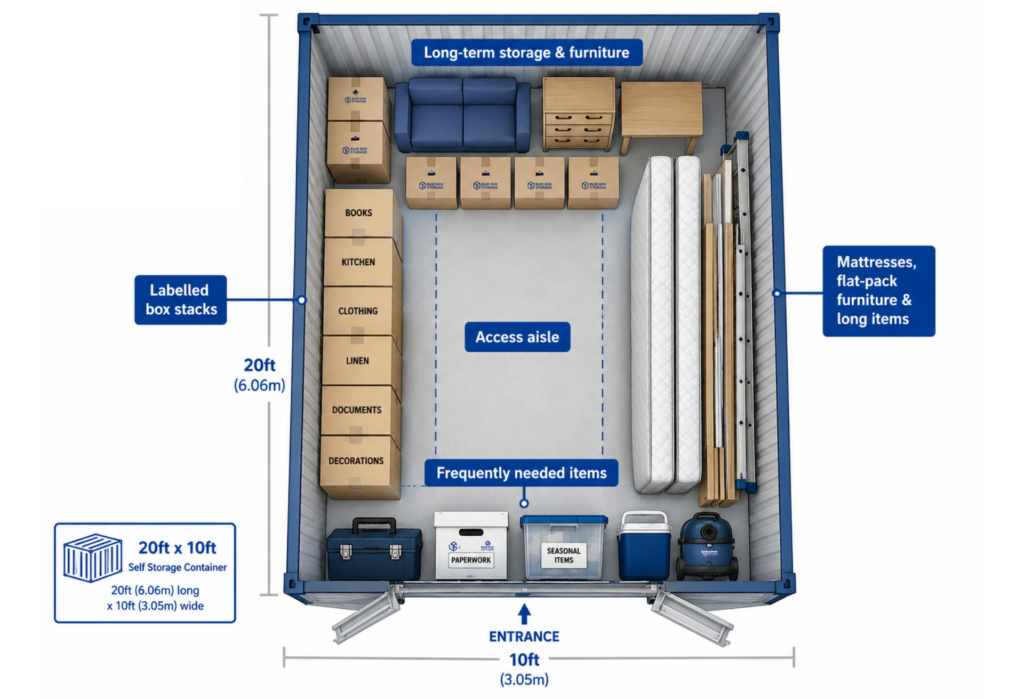
Sample storage unit layout
Here is a simple example for a 20ft container used during a house move.
| Area of unit | What to place there | Why |
|---|---|---|
| Back wall | Spare furniture, loft boxes, non essential household items | Least likely to be needed before move in |
| Left side | Box stacks by room, labels facing aisle | Easy to identify and retrieve |
| Right side | Mattresses, bed frames, flat pack furniture | Keeps long items protected and out of the way |
| Centre | Narrow walking aisle | Allows access without unloading everything |
| Front left | Tools, cleaning items, kitchen essentials | Useful during moving and setup |
| Front right | Important boxes, paperwork, children’s items | Easy to reach quickly |
| Door area | Items going out first | Prevents unnecessary searching |
For a 10ft unit, you may not have room for a full aisle, so use a front access zone and keep the most important items near the door. For a 20ft unit, a side or central aisle is usually more realistic.
Storage unit packing checklist
Before you move items into storage, use this checklist.
| Task | Done |
|---|---|
| Sort items by access priority | |
| Choose the right unit size for access, not just volume | |
| Use strong boxes in consistent sizes | |
| Label boxes on at least two sides | |
| Keep an inventory or photo record | |
| Pack heavy items in small boxes | |
| Clean and dry furniture before storing | |
| Protect mattresses and upholstery | |
| Keep fragile items clearly marked | |
| Place heavy items low down | |
| Keep frequent access items near the front | |
| Leave an aisle if you need regular access | |
| Store long items safely along side walls | |
| Keep screws and fixings labelled | |
| Check what cannot be stored before loading | |
| Photograph the final layout |
Common mistakes when packing a storage unit
One of the biggest mistakes is packing without a plan. People often think they will remember where everything is, but they rarely do. Once boxes are stacked and furniture is in place, everything looks more similar than expected.
Another mistake is using weak boxes. Supermarket boxes and old delivery boxes can be useful for short term moving, but they are not always strong enough for stacked storage.
Overfilling boxes is also a problem. A box that is too heavy is harder to lift, more likely to split and more likely to injure someone.
A fourth mistake is blocking access to the items you know you will need. Christmas decorations, suitcases, paperwork, tools and children’s items are often buried because they are small enough to fit into gaps. That makes sense in the moment, but not when you need them later.
Another common issue is storing things that should have been disposed of, donated or sold. Storage works best when it protects useful, valuable or meaningful items. It becomes expensive when it is used to avoid decisions indefinitely.
Before loading, ask whether each item is worth storing. If the answer is no, deal with it before it takes up paid space.
How to pack a storage unit so you can still find everything later
Finding things later depends on three habits: zoning, labelling and access.
Zoning means grouping similar items together. Labelling means making every box readable from the aisle or doorway. Access means leaving enough room to reach things safely.
If you only do one of these, the system weakens. A labelled box is not much use if it is buried behind a wardrobe. An aisle is not much use if every box says “misc”. A zone is not much use if the boxes are stacked with labels hidden.
The best storage units are not necessarily the neatest. They are the most understandable. You should be able to open the door and quickly know where the main categories are.
For example:
Left side: kitchen and living room
Right side: bedrooms and clothing
Back: furniture and long term storage
Front: tools, paperwork and essentials
That is enough structure to prevent confusion.
What to keep out of your storage unit
Not everything belongs in storage.
You should avoid storing food, perishable items, damp items, hazardous materials, flammable liquids, living things, illegal goods, and anything prohibited by your storage provider’s terms.
You should also think carefully before storing vital personal documents or daily essentials. Passports, medication, legal documents, urgent business paperwork and irreplaceable sentimental items may be better kept with you unless you have a specific reason to store them.
How often should you reorganise a storage unit?
You should reorganise a storage unit whenever your reason for using it changes.
If you originally packed it for a house move but then kept it for long term storage, the layout may no longer work. If you first used it for business overflow but now need weekly stock access, it may need shelving and clearer categories.
A good time to review your storage unit is:
- After a house move completes
- At the end of a renovation
- Before winter
- Before summer
- After a business stock change
- When you realise you are avoiding visits because the unit feels difficult to use
You do not need to empty the whole unit. Sometimes a simple front zone tidy, relabelling session or aisle clear out is enough.
How to pack a storage unit for seasonal items
Seasonal storage is one of the easiest categories to organise well because the access pattern is predictable.
Christmas decorations, garden furniture cushions, camping equipment, winter sports gear, summer toys, patio items and caravan accessories are usually needed at specific times of year.
Label these clearly and keep them grouped together. If you know you will need Christmas boxes in November, do not bury them behind furniture in July. If you know camping gear comes out every school holiday, keep it near the front during spring and summer.
For seasonal storage, plastic tubs can be useful because they are durable and easy to identify. Just make sure they are not overloaded and labels are still visible.
Is it better to use cardboard boxes or plastic tubs?
Both can work, but they suit different items.
Cardboard boxes are usually cheaper, easier to stack and better for general household moves. They are also easy to label and recycle. Good quality cardboard boxes are usually fine for most storage uses.
Plastic tubs are more durable and can protect against knocks, but they can crack if overloaded or stacked badly. They can also encourage people to throw random items together because the tub feels convenient.
For most people, the best approach is a mixture. Use strong cardboard boxes for general household items and plastic tubs for seasonal items, tools, children’s clothes, hobby equipment or things you may access repeatedly.
The key is not the material alone. It is whether the box is strong, labelled, sensibly packed and placed in the right part of the unit.
How to make storage easier when you come back
Packing well is only half the job. You also need to make future visits easy.
When you visit the unit, try not to undo the system. If you remove a box, put things back neatly. If you add new items, label them and place them in the right zone. If you take something from the back, use the opportunity to check whether anything else needs moving.
Do not keep adding loose items at the front. This is how storage units slowly become unusable. A few bags, a couple of tools, one box of paperwork and some loose decorations can quickly block access.
If you are adding items regularly, keep spare labels, tape and a marker in the unit or in your car.
For business storage, set a rule that stock is never left unlabelled. That one habit can save hours over the course of a year.
How to pack a storage unit safely
Safety matters because storage units often involve heavy items, awkward lifting and unstable stacks.
Do not lift more than you can safely manage. Use two people for heavy furniture. Keep walkways clear. Avoid climbing on boxes. Do not stack above a height that feels unstable. Make sure sharp tools, glass and metal edges are wrapped.
Wear sensible footwear and gloves if handling heavy or awkward items.
If you are using a removal company, explain your storage plan before unloading starts. Otherwise, they may pack quickly but not in the way you need. A fast load is not always a good load.
When to choose a bigger storage unit
A bigger unit may be the better option if you need access, have awkward furniture, are storing business stock, or are unsure how long the storage period will last.
This is not about paying for unused space. It is about paying for usable space.
A tightly packed smaller unit might work for one month. But if you are visiting regularly, adding items, removing items, or storing for longer than expected, the lack of access can become frustrating.
Choose a bigger unit if:
You need regular access
You are storing for business
You have bulky furniture
You need shelving
You want an aisle
You are storing during an uncertain move
You expect to add more items later
Final thoughts: how to pack a storage unit without regretting it later
The best advice on how to pack a storage unit is simple: pack it for the version of you who has to come back later.
That person will not remember which unlabelled box contains the kettle. They will not enjoy moving a sofa to reach a folder. They will not thank you for putting heavy books on top of fragile decorations. They will not want to empty half the unit in the rain to find one toolbox.
A good storage unit is organised, labelled and practical. Heavy items stay low. Fragile items are protected. Frequently needed items are near the front. Boxes are grouped by category. There is enough access to move safely. The layout makes sense when you open the door.
Whether you are storing household furniture, business stock, tools, seasonal items or belongings during a move, the goal is not simply to fit everything in. The goal is to store it in a way that protects your belongings and saves you stress later.
If you are looking for secure, flexible storage in Doncaster, Blue Box Storage offers container storage options for household, business and longer term use, with clear pricing and practical unit sizes. A quick conversation about what you are storing can also help you choose the right space before you start loading.

About the author:
Harry Merrett
Director of Blue Box Storage Doncaster
He is the Director of Blue Box Storage Doncaster and has helped hundreds of Doncaster residents safely store belongings in one of the highest rated outdoor self storage facilities in Doncaster on Google. He has ensured Blue Box Storage remains accredited with the Self Storage Association and a Platinum Accreditation with the CaSSOA.
Follow Harry on LinkedIn here.
Get in touch to secure your storage
Recent Posts
Does Caravan Storage Affect Insurance? What Owners Should Check Before Choosing a Site
Caravan storage can affect your insurance because insurers often rate risk based on the storage location, site security and whether the compound is CaSSOA accredited. This guide explains what to check with your insurer and what details to confirm with a storage provider before you move or renew.
Storage for Sports Equipment in Doncaster: Secure Container Storage
Need storage for sports equipment in Doncaster? This guide explains what you can store, how container storage protects your kit, how to prevent damp and rust, and how to choose the right unit size at Blue Box Storage.
How To Organise A Kitchen: Practical Ideas For A More Functional Space
A well-organised kitchen makes everyday life noticeably easier. Whether you're preparing family meals, grabbing breakfast before work or trying to keep on top of the washing up, knowing exactly where everything belongs saves time, reduces stress and makes the room far more enjoyable to use. Learning how to organise a kitchen isn't about buying expensive […]
Our Accreditations

Visit us
Unit 1 Sandall Business Park, Sandall Stones Road, Kirk Sandall, Doncaster DN3 1RW
Phone
01302 593593
Email
[email protected]
© Copyright 2024 Blue Box Storage. All rights reserved.
Sitemap